Bitcoin's $87K Rejection: The 2026 Cycle Is Starting to Show Its Shape
Bitcoin recovered from roughly $58k to $87k, ETF inflows surged, leverage rebuilt, then the first meaningful deleveraging wave arrived. $82–83k held. The tail is not here. Several pieces of the map written down in advance have begun to appear.
Get the next letter by email →

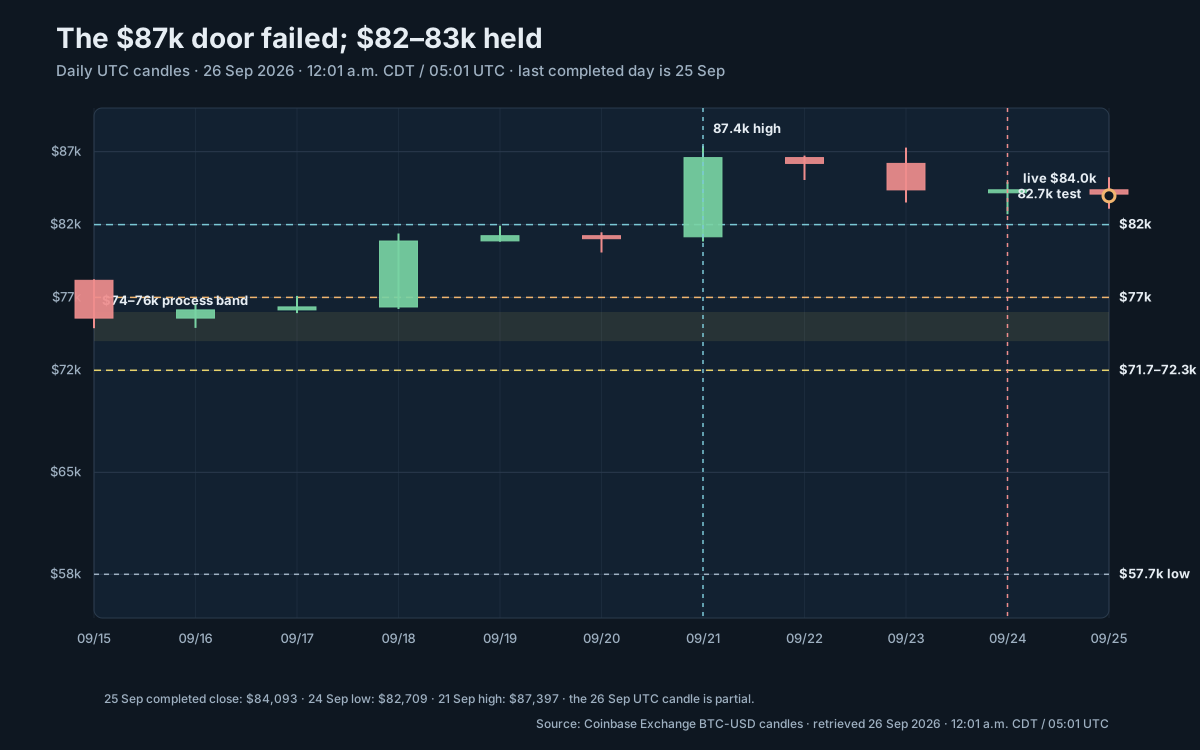
As of 26 September 2026, 12:01 a.m. Central / 05:01 UTC, Coinbase BTC-USD was about $83,976. The last completed UTC daily candle, 25 September, closed at $84,093 after trading from $83,091 to $85,250. The 26 September UTC candle is only a few hours old and is not used as a completed-day fact. Coinbase ticker · Coinbase daily candles
1. The central answer
Observed: Bitcoin rejected from a $87,397 high, lost the $85–86k holding zone, then probed $82,709 on 24 September and closed back above $84k. US spot Bitcoin ETF flows stayed positive through 25 September while the size of those daily inflows decelerated. Open interest kept bleeding. Funding moved toward neutral. Calculated: the 21 September close to the 25 September close was −2.9%, even as Farside recorded about +$2.39B of reported inflows across those five sessions. Inferred: several pieces of the 2026-cycle map written down before this move have begun to appear. The tail has not.
We are still early. The approximately $57.7k low may have been the completed bear-market bottom. It may also have been first capitulation. The evidence still does not decide that. The desk decision remains WAIT.
2. The last 72 hours
Issue 26 froze on the evening of 23 September at about $84,354, after a 4.3% high-to-low reversal and a long-liquidation wave as Bitcoin lost $84k. What happened next is the new packet.
On 24 September, Coinbase traded from $82,709 to $84,930 and closed at $84,385. That is the first completed daily test of the $82–83k door Issue 26 named in advance. The door was probed. It was not accepted through. On 25 September, price reached $85,250, fell back to $83,091, and closed at $84,093. Secondary reports of Friday liquidations were much smaller than Wednesday’s flush: CoinGlass windows cited in market copy clustered around tens of millions of dollars of Bitcoin longs, not hundreds. Bitcoin.com market note · TokenPost / venue liquidations
Two other facts arrived in the same window. Farside’s completed 23 September ETF row is +$346.9M, not the preliminary +$32.4M Issue 26 had to mark as incomplete. And Bitget disclosed a hot-and-warm-wallet incident detected at 18:31 UTC on 24 September. Those are separate facts. They are not automatically one story.
3. What Paramaribo said before the move
This desk does not get to rewrite the ledger. The public letters start on 22 August 2026. They did not forecast the October 2025 top. They did map doors after that top was already in the tape.
| Issue | Frozen price | What we said | Next gate | What happened afterward |
|---|---|---|---|---|
| 23 · 17 Sep | ~$76.6k | Don’t skip to $28k. Daily $77k is gone. Next argument is $72k / the 50-day. | $71.7–72.3k | Price never made $72k the working test. It reclaimed $81.5k and reached $87.4k first. |
| 24 · 18 Sep | ~$77.6k | The bid went missing. ETF outflows and weak spot CVD. Next pool $74.6k, then $72k. Extreme $28–35k still a tail. | $74.6k | ETF flows flipped positive. The $74.6k pool was not visited. Demand repaired faster than the near-map expected. |
| 25 · 22 Sep | ~$86.3k | $87k cleared the door, not the room. One close above $81.5k. $86k still needed a second close and a support test. | $86k as support | The next completed day closed at $84,378 after a $83,513 low. $86k failed as support. |
| 26 · 23 Sep | ~$84.4k | Still early. First meaningful deleveraging, not a tail. Next doors $82–83k, then $80k, then $77k. WAIT. | $82–83k | 24 Sep low $82,709, close $84,385. The first support door held on a daily-close basis. $85–86k was not reclaimed. |
Two simultaneous truths: the desk was right not to promote a tail from $76k, and it would now be wrong to pretend $81.5k never cleared. Issue 27 freezes the new ambiguity. It does not recast Issues 23–24 as secret $87k calls.
4. The $87k rejection
The sequence is now complete enough to name. The 18 September candle first traded above $81k. The 21 September candle reached $87,397 and closed at $86,595. The 22 September candle reached $86,734 and closed at $86,198. On 23 September a second attempt above $87k failed: high $87,283, low $83,513, close $84,378. No completed day since has closed back above $86k. The highest subsequent high is 25 September’s $85,250.
Using completed Coinbase closes through 25 September, calculated SMA20 / SMA50 / SMA100 / SMA200 were approximately $79,957 / $75,322 / $69,276 / $70,930. RSI14 (Wilder) was 64.3. MACD remained positive, with the histogram down to about +$395 from Issue 26’s +$569. Price is still above its major averages. Momentum has rolled over from the squeeze, not broken. Observed and calculated, not a forecast.
5. The ETF paradox
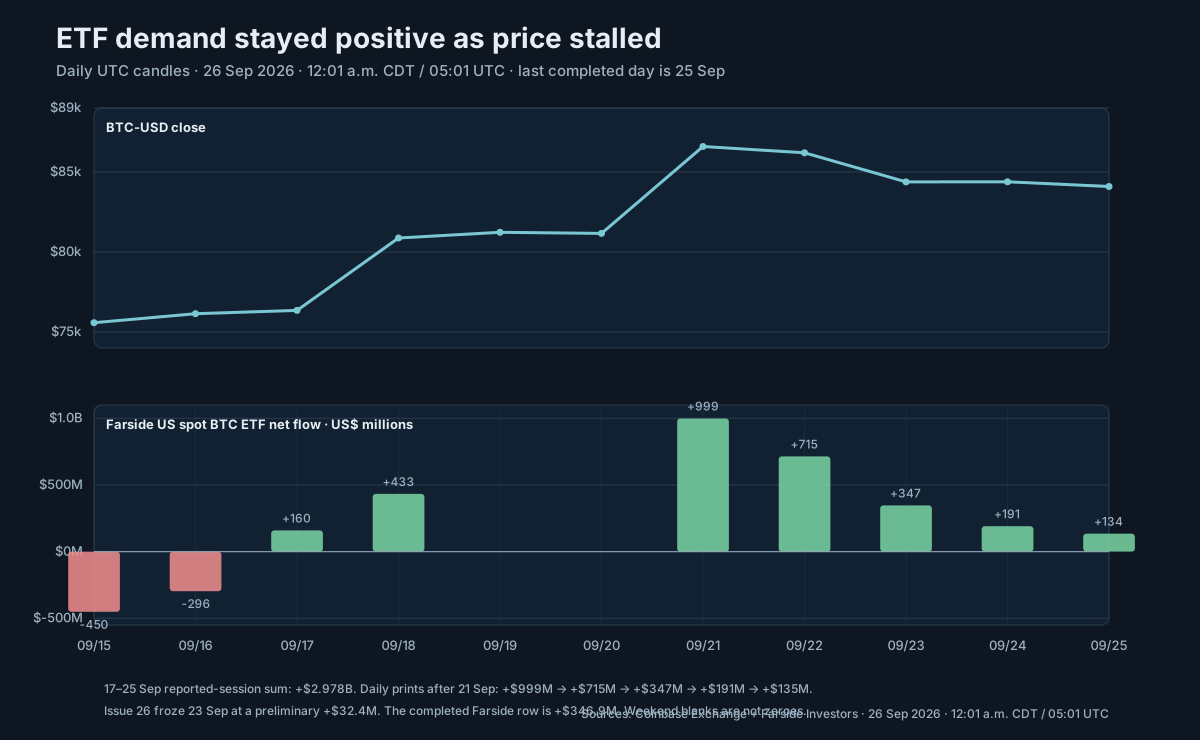
Vehicle-level demand did not vanish when price failed. Farside’s US spot Bitcoin ETF table, retrieved 26 September, shows −$450.4M and −$295.9M on 15–16 September, then +$159.5M, +$433.0M, +$999.0M, +$714.7M, +$346.9M, +$190.7M, and +$134.5M across the reported sessions from 17–25 September. That is about +$2.978B of net reported creations over seven sessions. It is also a straight deceleration from the $999M print. Farside Bitcoin ETF flow table
Issue 26 had to treat 23 September as preliminary (+$32.4M, several issuer cells blank). The completed row is +$346.9M. That revision is friendly to the cash-demand case. It does not erase the slope: +$999M → +$715M → +$347M → +$191M → +$135M. Positive and slowing can be true at the same time.
Do not say “ETF inflows before crashes are bearish.” That is a slogan. The question is the transmission mechanism: creations, authorized-participant inventory, cash versus in-kind, NAV arbitrage, CME or perpetual hedges, and the identity of the marginal seller. This packet has the vehicle-level tape. It does not have creation quality, AP books, or a clean CME basis series. Those stay MISSING / NOT VERIFIED.
6. ETF absorption divergence
This issue names a research concept, not a trading signal.
ETF absorption divergence: ETF Bitcoin demand is still rising on a multi-day cumulative basis, while the price response has weakened. From the 21 September close of $86,595 to the 25 September close of $84,093, Bitcoin fell about 2.9% while Farside recorded about +$2.39B of inflows. If the ETFs are accumulating, someone else is supplying that bid.
Possible explanations, none of them proven here: genuine institutional accumulation overwhelmed by other sellers; long-term-holder distribution; miner or corporate supply; crypto-native funds reducing; in-kind creations that do not add the same incremental spot impulse as a panicked cash bid; basis or hedge-offset trades; or ordinary digestion after a squeeze. GBTC’s recent Farside cells were 0.0 on 23–25 September, so the old GBTC-outflow story is not the current print.
A secondary research note said Monday’s inflow was the largest single day since record inflow levels last October. That is a hint, not a reconstructed 2025 series. This freeze did not retrieve a verified October 2025 Farside tape of “large inflows → fading momentum → price weakness → flow reversal → liquidation.” Do not claim the pattern repeats because the rhyme is convenient. The 2025 analogue remains INSUFFICIENT EVIDENCE.
What the concept is allowed to do: put a watch on flow rate-of-change, not just the sign. A redemptive day after this deceleration would be a different fact than another +$100M print that price ignores. What it is not allowed to do: declare distribution, or declare a crash, from a five-session slope.
7. Leverage just reset — that matters
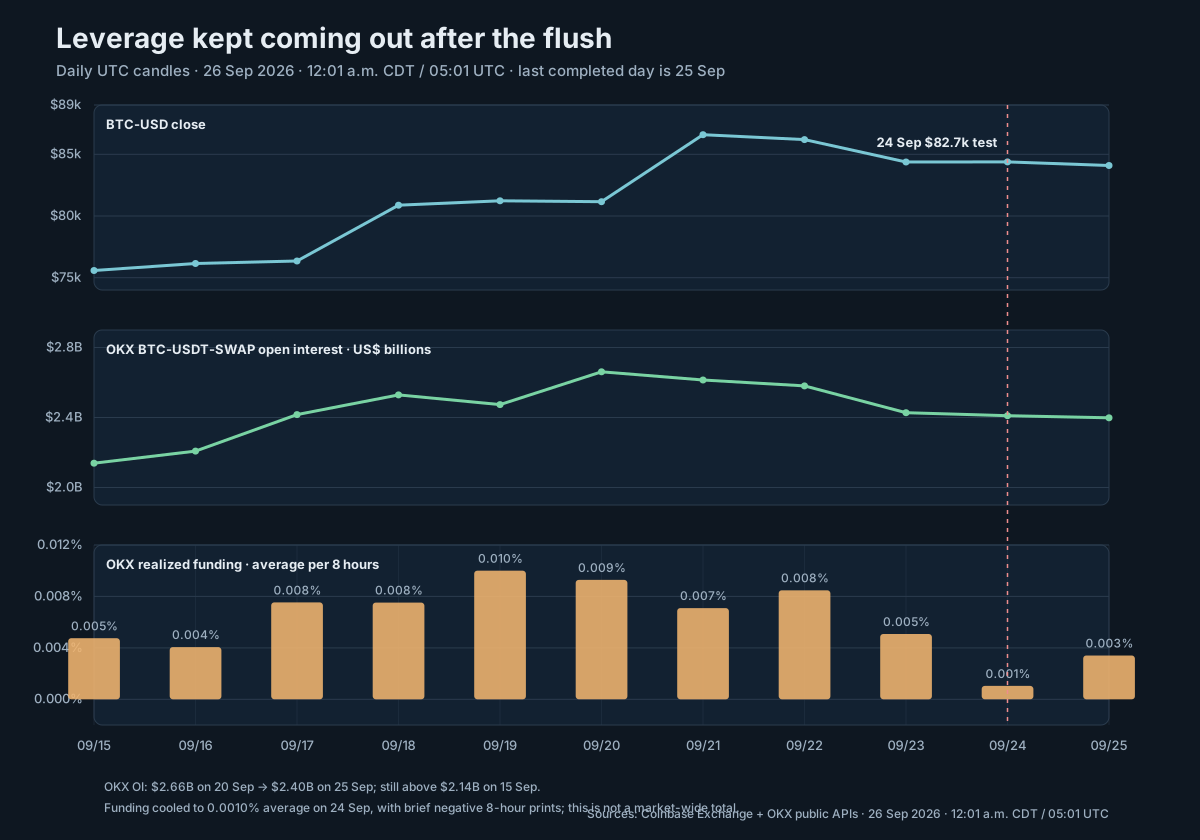
OKX BTC-USDT perpetual open interest was about $2.66B on 20 September, $2.43B on 23 September, $2.41B on 24 September, and $2.40B on 25 September. That is a calculated 9.9% decline from the local peak, and it is still above the 15 September baseline of $2.14B. Average realized funding cooled from 0.0085% per eight hours on 22 September to 0.0010% on 24 September, with brief negative 8-hour prints on 24 and 25 September, then 0.0034% on 25 September. Current implied funding at the freeze was about 0.0020% per eight hours. OKX OI · OKX funding
Venue-specific deleveraging is not a market-wide vacuum. It is still the right mechanism to watch. The 23 September long flush showed that rebuilt leverage can reverse a squeeze quickly. The 24–25 September tape showed a quieter version of the same machine: smaller liquidations, a $82.7k wick, a close back in the mid-$84,000s. A healthy reset and the first leg of a cascade can look similar at this distance. The difference is whether $82k, then $80k, then $77k fail with rising intensity. They have not.
8. The four-year clock
Previous mature Bitcoin bear markets reached terminal lows roughly one year after their cycle tops. Commonly dated marks, which disagree slightly by venue, are approximately: 30 November 2013 → 14 January 2015 (about 410 days, on the order of −85% to −87%); 17 December 2017 → 15 December 2018 (about 363 days, about −83% to −84%); 10 November 2021 → 21 November 2022 (about 376 days, about −77% to −78%). Sample size: three. That is not a law.
This cycle’s Coinbase high in the retrieved series is $126,296 on 6 October 2025; CoinGecko’s ATH is $126,080 the same day. The 2026 Coinbase daily low in this series is $57,718 on 1 July — about 268 days after the top. Today is about 355 days after 6 October 2025. The 363- and 376-day analogues fall in early-to-mid October 2026. The 410-day analogue falls near 20 November 2026. The July low arrived early versus that window. That is a fact about timing, not a proof that another low is owed.
Cycle compression is a legitimate competing explanation: shallower drawdowns, faster recoveries, ETFs, and a larger bid. A later low without a new cycle-bottom print is also possible. The clock is a way to keep sequence and duration separate. Mid-November is not an appointment.
9. The depth problem
Peak-to-trough depth has stepped down across modern cycles: on the order of −85% (2013/15), −84% (2017/18), −77% (2021/22). From $126,080 to $57,718 is about −54%. From the same high to this freeze is about −33%. Institutionalization, ETF absorption, and a larger stablecoin float can explain a shallower basin. They can also explain a slower, time-based capitulation that never revisits −70%. They cannot, on this sample, prove which one this is.
Separate the claims. Later-low and $38k are not the same sentence. A later 2026 low can print above $57.7k, near it, or through it without ever tagging a 70% drawdown. $38k is a severe-tail reference corresponding to roughly a 70% drawdown from ~$126k. It is not the incomplete-reset hypothesis, and it is not the base case.
10. Model A — $58k was the bottom
Path: ~$126k → ~$58k → bear bottom complete → recovery → ~$87k → normal correction → bull expansion.
Evidence that still supports it: price above SMA20/SMA50/SMA200; MACD still positive; ETF creations net positive for seven reported sessions; stablecoin pegged-dollar supply about $314.0B versus about $313.0B at the Issue 26 freeze; a $82.7k probe that was absorbed on the same daily close; Fear & Greed at 74 (Greed), not a panic print; S&P 500 and Nasdaq Composite higher than at the Issue 26 freeze; no verified daily loss of $80k, $77k, or the 2026 low.
Model A’s job from here is to prove demand after the forced buying is gone. Two daily closes above $86k with persistent creations and orderly open interest would do more for this case than another green ETF day that price ignores.
11. Model B — the final low is still ahead
Path: ~$126k → ~$58k first capitulation → powerful recovery → confidence rebuild → leverage rebuild → ~$87.4k potential sweep → deterioration → progressive support failures → final 2026 bottom.
Evidence that still supports it: the $87.4k rejection and the loss of $85–86k; ETF absorption divergence; OI still above the pre-squeeze baseline; historical timing that treats July as early; a shallow −54% versus prior cycle depths; hostile yields and a market that is pricing a material chance of another hike; a security event that raised infrastructure stress even if it has not shown contagion.
Model B does not need $38k. It needs sequential failure. Until $82k, then $80k, then $77k print as accepted losses, Model B is a watch, not a destination.
12. The confirmation road
| Node | Status at this freeze | What confirms it | What invalidates the path |
|---|---|---|---|
| $87.4k sweep | Printed 21 Sep; second test failed 23 Sep | Durable reclaim with flow persistence | Repeated lower highs under $86k |
| $85–86k | Lost as a holding zone; 25 Sep high $85,250 | Daily closes above $86k | Failure, then close below $82k |
| $82–83k | Tested 24 Sep (low $82,709); daily close held | Hold on daily closes while OI resets | Close below $82k, then no 48-hour reclaim |
| $80k | Not visited | Reclaim after a sweep with spot participation | Acceptance below it reopens the old correction map |
| $77k | Not visited since the squeeze | Holds with ETF and spot repair | Two daily closes below it |
| $74–76k | Process band from Issues 23–24; not in play | Orderly test and reclaim | Fast loss with rising liquidation intensity |
| $71–72k | Next structural decision near the 50-day if $77k fails | Hold and recover | Daily acceptance below it |
| ~$57.7k | 2026 low / cycle-bottom gate; still holds | Sweep-and-reclaim strengthens Model A | Break and failed reclaim with forced selling |
| ~$38k | Severe-tail reference only | Every prior door fails with depth and collateral stress | Any durable recovery above the failed door |
Relief rallies and lower highs can appear anywhere on this road. They are not a reason to skip a door.
13. Why this is not Tail Panic
Tail Panic is a market state, not a red candle. The required cluster would include price-structure failure, financial-conditions deterioration, ETF marginal-demand deterioration, OI/funding instability, liquidation acceleration, volatility expansion, market-depth deterioration, on-chain profitability deterioration, and cross-asset stress. Count what is actually present.
Present: a failed $87k breakout; some financial-conditions heat from yields; ETF deceleration; venue OI down from the peak. Absent: accepted loss of $82k/$80k/$77k; ETF outflows; a panic Fear & Greed reading (74 / Greed); a second large liquidation wave; a Deribit DVOL spike into crisis (last hourly print about 34.6); a stablecoin break; a verified on-chain profitability rollover; equity-market stress (S&P and Nasdaq were higher than at the Issue 26 freeze). That is first deleveraging plus a digestion, not the state.
14. The November window
Working timing hypothesis, still conditional: late September can contain initial deterioration; October can contain lower highs and support tests; late October / early November can contain structural deterioration; mid-November is a potential Tail Panic window only if preceding gates confirm. If market structure remains strong, downgrade the hypothesis. Do not move the date forward to save the theory.
At this freeze, late September has produced a rejection and a held $82–83k test, not a cascade. October is allowed to be two-sided. Mid-November remains a hypothesis window, not a calendar trade.
15. Percent Entities in Profit
Glassnode’s Percent Entities in Profit, and the 30-day profitability-momentum turn reportedly near ~$64k in mid-August, were not independently retrieved for this freeze. Missing stays missing. The desk will not fight an indicator it cannot see, and it will not borrow a screenshot as a regime call.
What can be said without that series: Fear & Greed at 74 argues against declaring Tail Panic from sentiment. Price is still ~46% above the 1 July Coinbase low. If profitability momentum were rolling over hard, this letter would want that print in the packet before using it as independent confirmation. It is not in the packet.
16. Global M2: the bullish counterargument
No new monthly prints were required to change the direction of the last release set. US M2 was $23.34T in August, up from $22.09T a year earlier. China’s August M2 growth was reported at 7.5% year over year. Euro-area M3 grew 3.4% in July. Japan’s August M2 grew 2.0%. US H.6 · ECB · BOJ
M2 is not market liquidity, not credit availability, not risk appetite, and not leverage. There is no fixed M2-to-Bitcoin lag in this packet. Rising broad money can argue against a prolonged post-crash depression more strongly than against a temporary liquidation. That is the bullish counterargument. It does not invalidate a fast drawdown, and it does not time one.
17. Rates and financial conditions
Yahoo Finance snapshots at this freeze: DXY about 101.04, US 10-year yield 5.184% (Issue 26 freeze: 5.114%), 30-year 5.504%, 5-year 5.007%, 13-week bill 4.07%, 2-year yield futures 4.50%. WTI about $92.41. Gold about $4,321. S&P 500 7,743. Nasdaq Composite 27,069. VIX 14.87. USDJPY about 157.2. US 10-year · DXY
Secondary reports on 25 September put the 10-year intraday high near 5.23% and CME FedWatch October 25 bp hike odds in a roughly 70–75% band. Those odds were not scraped live from CME in this freeze; treat them as secondary and perishable. The Fed’s target range remains 3.75–4.00% after the 16 September hike.
Transmission, not slogans: higher real-ish yields raise the hurdle rate for a non-yielding asset, tighten financial conditions, and can force duration and basis books to cut. They do not mechanically liquidate Bitcoin on a one-day beta. Equities holding up while Bitcoin digesting a squeeze is mixed, not a synchronized risk-off crash. Hostile yields are a pressure. They are not, by themselves, Tail Panic.
18. Crypto infrastructure stress
Bitget is in the packet because it is verified, not because it completes a narrative. The exchange said unauthorized transfers from hot and warm wallets were detected at 18:31 UTC on 24 September. Later accounting put affected assets at about $387.5M, above an initial ~$352M figure, with Zcash and TRON added to the tally. CEO Gracy Chen said attackers spoofed transaction data in a backend wallet system and triggered authorization; private keys, in her account, were not taken. Withdrawals were paused. Deposits and trading were left open. Bitget said a user-protection fund above $464M would cover losses. Mandiant and SlowMist were named as investigators. A North Korea link has been suggested and is not confirmed in public technical evidence. Bitget incident update · CoinDesk
CoinDesk also recorded a separate September incident: the Liquid Network, about $320M, earlier in the month. Classification: security events, elevated. Systemic contagion: not demonstrated. Bitcoin probed $82.7k the same UTC day as Bitget’s disclosure and closed $84,385. No stablecoin depeg is in this packet. Do not declare Bitget the wild card after the fact. A headline matters only if it propagates into funding stress, withdrawal runs, market-maker pullback, or forced sales. That propagation is not shown here.
19. Machine speed
Hypothesis, not established fact: AI assistants, algorithmic execution, autonomous agents, risk engines, market makers, and liquidation engines can compress the time between information and forced positioning. The opposite force is also plausible: automated market making, arbitrage, and risk controls can absorb a dislocation faster. Automation may increase both displacement speed and recovery speed.
No evidence in this freeze isolates AI as the cause of 23 September’s flush or of the 24 September $82.7k wick. The observable mechanism remains leverage plus a failed breakout, with yields as background pressure. Machine speed stays on the research list. It does not get to author the tape.
20. BTC dominance and what comes after
CoinGecko global data put Bitcoin dominance at about 58.3% (Issue 26 freeze: 58.8%). That is still the 57–58% area the desk has been watching. It has not broken down. A working hypothesis — elevated BTC.D through risk-off, with a dominance break only after a Bitcoin bottom or recovery — would matter later for altcoin or PENGU rotation. It is not evidence of that rotation today. Do not use a projected dominance collapse as a current input. PENGU and the broader alt tape were not the object of this freeze.
21. What would prove Controller wrong
The Controller overlay remains a hypothetical assumption inside a long-range scenario that takes 2030 as an assumed major global reset. That 2030 date is not observed fact and is not debated inside the overlay. It is also not proof that Bitcoin must crash in 2026. The overlay’s 2026 role is “reset / bottoming year.” A market that reclaims $86k, then $87.4k, with persistent ETF creations, stable OI, and no sequential loss of $82k/$80k/$77k would falsify the immediate Controller road. Two daily closes above $86k are the first observable kill-switch. A new high by itself is not enough; demand quality is part of the test.
If those kills print, downgrade the overlay. Do not move November. Do not invent a later appointment to keep the story alive.
22. What would strengthen Controller
A daily close below $82k, then $80k and $77k, with ETF outflows rather than merely slower inflows, rising or disorderly liquidation intensity, weakening spot participation, and cross-market stress would strengthen it. Failure at $71–72k, then below the approximately $57.7k low, would move the final-low case from hypothesis toward evidence. $38k still would not become the base case until that stack failed with forced selling that can be shown. The date still would not become an appointment.
23. What the conductors disagree about
Independent first-pass lenses on this packet clustered. They did not vote.
Market structure. bang_technician, killa_quant, options_vol, and capriole_systematic treated the $82.7k sweep-and-close as a reason to keep observing, not to chase. They disagreed on how much credit to give the still-positive averages. Deribit BTC options open interest in this freeze was call-heavy (put/call about 0.52), with large October 90k/95k/100k call open interest and DVOL near 34.6. That is not a crash-put crowd. It is also not a dealer-gamma proof; gamma was not derived.
Flows and plumbing. bitwise_fundamentals, cryptoquant_flows, policy_regulation, and carter_monetary agreed that the ETF sign is still the strongest institutional fact and that the slope is the new fact. They refused to name the seller. glassnode_onchain had no fresh LTH/STH, SOPR, or Percent Entities in Profit series and said so.
Macro and credit. macro_liquidity, hayes_crypto_credit, and cowen_cycle_risk saw higher yields and a still-elevated 58% dominance as pressure, not as a completed risk-off regime. Equities up, Bitcoin digesting, and stablecoin supply still expanding is a mixed tape. leopold_ai_scaling, eth_platform, hasu_incentives, murad_meme, earnings, and chatter found no verified special catalyst in their lanes.
Process. chief_of_staff kept the inherited rule: update the doors, do not rewrite Issues 23–26, do not promote $38k, do not move mid-November. risk_red_team’s attack is in the next section; it is the reason the weights do not lurch toward Model B.
24. What we still don’t know
- Who is supplying BTC into ETF creations — LTH, miners, corporates, basis books, or ordinary two-way flow.
- Whether creations are cash or in-kind, and whether they are being hedged in CME or perps. CME basis: MISSING.
- Whether the 2025 October inflow-then-liquidation sequence actually happened in the form the rhyme wants. Historical Farside tape: NOT VERIFIED in this freeze.
- Percent Entities in Profit and 30-day profitability momentum: MISSING.
- Multi-venue open interest, a primary liquidation heatmap, and order-book depth: MISSING.
- Whether $57.7k is a completed bottom or first capitulation.
- Whether Bitget residual stress shows up in funding, stablecoin floats, or market-maker depth next week.
- What, if anything, would constitute the wild card. Status: UNKNOWN.
25. The map
Four paths through 15 December, director synthesis, sum 100. These are scenario weights, not prices, not tickets, not advice.
| Scenario | Weight | Path | Confirm | Invalidate |
|---|---|---|---|---|
| Model A / bull repair | 20% | Hold $82–83k, reclaim $86k, treat $87.4k as a digestion | Two UTC closes >$86k with ETF persistence and orderly OI | Daily close <$82k, then loss of $80k without flow repair |
| Base / orderly re-range | 50% | Digest $82–86k while leverage finishes resetting | Repeated closes inside the box; mixed but non-redemptive flows | Two closes >$86k, or accepted loss of $80k then $77k |
| Model B / structural failure | 22% | $82k, then $80k, then $77k, toward $74–76k / $71–72k | Daily close <$82k without a 48-hour reclaim, then $80k/$77k | Reclaim $86k with flow repair |
| Severe tail | 8% | Only after $57.7k fails with forced selling; ~$38k is a reference, not a target | Daily <$57.7k with failed reclaim plus pulled ETF/OI/credit stress | Hold of $82–83k into a durable $86k reclaim |
Issue 26’s four-path card was 20 / 45 / 25 / 10. The $82–83k hold and still-positive ETF sign nudge the base up and the tail down. They do not elect a winner. The Controller’s 2025–2030 scaffolding — 2025 peak, 2026 reset, 2027 reconstruction, 2028 expansion, 2029 late-cycle, 2030 assumed reset — remains a hypothetical calendar inside one model. The observed 2026 tape currently fits that sequence only in the weak sense that a rejection happened after a recovery. That is not confirmation.
26. One card
We are early.
The $87.4k print has so far behaved like a sweep. The $82–83k door, named before the 24 September wick, held on a daily close. ETF demand is still present and no longer accelerating. Leverage came out. Yields are hostile. Bitget is a security event, not demonstrated contagion. Fear & Greed is 74. The tail is not here.
The road still runs through $85–86k on the upside and $82–83k, $80k, $77k, $74–76k, and $71–72k on the downside before the severe-tail hypothesis earns the right to discuss approximately $38k. Mid-November is a hypothesis window, not an appointment.
The strongest competing hypothesis remains simple: approximately $58k was already the bottom. The strongest bear revision is not “the crash has started.” It is “the mechanism is observable, and flow momentum is no longer doing the bull’s work for free.”
Wild card: UNKNOWN.
Decision: WAIT.
Sources
- Coinbase BTC-USD ticker and daily candles — spot and completed UTC structure; freeze 26 September 2026, 05:01 UTC.
- CoinGecko Bitcoin market data and global market data — ATH, market cap, volume, dominance.
- Farside Investors — US spot Bitcoin ETF flows through 25 September 2026; 23 September now a completed row.
- OKX open interest, funding, and spot ticker — venue-specific derivatives and premium snapshot.
- Deribit options and volatility-index history — implied volatility and book observations; dealer gamma not inferred. DVOL last hourly print about 34.63.
- Alternative.me Fear & Greed and DefiLlama stablecoins.
- Yahoo Finance chart snapshots — DXY, 10-year, 30-year, S&P 500, Nasdaq, WTI, gold.
- Federal Reserve H.6, ECB monetary developments, BOJ money stock — inherited last-release M2/M3 set; no new monthly print in this freeze.
- Bitget incident update, CoinDesk 24 Sep, CoinDesk 25 Sep — security event; contagion not demonstrated.
- Bitcoin.com, TokenPost, Decrypt — secondary liquidation and options-expiry reports; windows differ and are used directionally.
Educational-not-financial-advice disclaimer. This letter is educational scenario research, not personalized financial advice. It does not recommend buying, selling, leverage, or any position size. Levels are observation points, not instructions. Cash is a valid position when confirmation is absent. Named traders and firms are analytical lenses only. Observable evidence overrides every model, including the Controller. The 2030 reset inside that model is a hypothetical assumption, not observed fact.
Educational scenario research. Not personalized financial advice. No execution, no position sizing, no leverage recommendation. Older issues remain in the archive and are not removed when a new letter is posted. Read who the agents are.